Friday, September 9, 2011

In Her Shoes

STILETTO, a dagger developed in southern Europe and in common use in the 16th century. It had a slender blade about six inches (15cm) long that tapered to a sharp point. Employed only as a stabbing weapon, the stiletto's blade had no cutting edge, but was three- or four-sided to give it firmness and strength. Some stilettos were sturdy enough to penetrate light armor, and some were so small and light that they could be used by a woman. The stiletto's handle was protected by a simple cross guard, or quillon. [Encyclopedia Americana, c. 1980 Americana Corporation.]


In my fashion I was thinking of the Twelve Dancing Princesses so I thought I'd rework a composition in acrylics I'd sent off last Christmas as a gift - some shoes in vibrant hues, hues with a 60s vibe. As I worked with the sketches and colors I heard over and over in my mind, "Why, then is my pump well flowered."

Why was the Creative Voice directing me to "Romeo and Juliet" as I painted fanciful shoes? Was it just that women's high heels are also called pumps? Repeatedly, in my mind, I circled around the prompt of Romeo and pumps, closer and closer until I finally hit the mark: heels, pumps, stilettos. Then: stiletto, dagger, Juliet. On the heels of that revelation came the epiphany that the stiletto, a type of dagger, was Will Shakespeare's incredibly elegant and compact icon describing much about his 'Juliet,' his 'Dark Lady.'

Previously I posited that Juliet's manner of death, stabbing herself with a dagger, was actually a dramatization of the Lucan paradox (Luke 17:33), "Whoever seeks to save his life will lose it, and whoever loses his life will preserve it." This woman had chosen to take her life in her own hands. She would guide her destiny.

It is worth exploring now the wider significance with which the playwright imbued the stiletto. Given the references in the play to soles and pumps I believe Will Shakespeare is telling us that his love, his 'Juliet,' his 'Dark Lady' took her financial welfare in her own hands as well and was, in some way, associated with shoemakers, or 'cordwainers' as they have been called for centuries.

My research of the Cordwainers turned up at least two facts I find most interesting and pertinent to this discussion. It is significant to note that the Worshipful Company of Cordwainers is and was located in Cheapside in London - just a ten minute or so walk from the Globe Theater.

Another fact, to which the playwright may be alluding when the Nurse indicates that whoever marries 'Juliet' will have 'the chinks,' is that Henry VI granted the guild a Royal Charter in 1439. A Royal Charter was an important and positive development for a business then, as I believe it is now. This charter likely means that the Company of Cordwainers were shoemakers to the monarchy.

It would be interesting to know the 'Dark Lady's' exact association with the cordwainers. Did she own a shop? Did she herself make shoes? Perhaps she designed them? Unfortunately, there is a very slim chance anything can be learned from the company's records because in 1666 the original hall burned down and most of the records were lost.

The longer I consider the dominant revelation that 'Juliet' took control of her own life by use of a stiletto, a stiletto Shakespeare also wants us to know is a shoe, I find myself wondering if the 'Dark Lady' felt compelled, even at a young age, to fashion for herself a pair of shoes that in some way used actual stilettos as heels. If so, why?

Why would a young girl - a girl barely a teenager and a bookworm, if I read Lady Capulet's lines aright; a girl ardently sought as a bride; a girl Romeo describes as "Beauty too rich for use, for earth too dear" - feel it necessary to include stilettos in the fashion of her shoes?

I can only surmise that her beauty, financial wealth, and elevated social status (perhaps nobility) were threats to her welfare at times. Her choice of a stiletto tells me she absolutely meant to defend herself should she find herself cornered, backed against a wall. It would be a close, dangerous fight, but fight she would. Further, if she was of noble birth, her beauty would likely have been known to the court. She may often have been present at court. Those stilettos would have served as a distinctly unquestionable warning to any lotharios. You'd best watch your step when you dance with a woman wearing those shoes.

This focus on 'Juliet's' shoes fleshes out for us the relationship between herself and Romeo, the 'Dark Lady' and Will Shakespeare. When 'Juliet' muses, "What's Montague? It is nor hand, nor foot," perhaps the line references the son of the glover and the shoemaker? Romeo's line in Act II Scene iv, "Why, then is my pump well flowered," gives us a much more intimate look at the relationship between the playwright and the Beauty. In addition to the sexual connotation I believe it tells us that Will Shakespeare wore shoes from the 'Dark Lady's' shop. Perhaps they also were 'too rich for use' and 'too dear' to be worn on other than grand court occasions?

Beyond that, however, I believe Will Shakespeare was dramatizing for us his theme of "the marriage of true minds." I have written elsewhere that the playwright was presenting the 'Dark Lady' to us as a figure embodying love, compassion, mercy and enlightenment, someone committed to and involved with all living and suffering. When Will Shakespeare tells us he wore 'Juliet's' shoes he is is telling us that like the 'Dark Lady' he puts himself in the shoes of others and walks the path of compassion in hope of guiding others to enlightenment.

Does he not use the language of heavenly bodies of light, the Sun and the stars, to characterize Romeo and Juliet? It is not hard to imagine that he caught the double meaning of 'sun' in Spanish, el Sol, and the sole of a shoe!

The playwright characterizes this facet of their relationship upon this path in "A Midsummer Night's Dream" as being "of imagination all compact." Both lovers, crazy perhaps for their imaginings, were poets, their hands composing feet into verses out of respect for and commitment to humanity.

Will Shakespeare used the trend for exaggerated heel height to characterize his 'Juliet's' elevated consciousness. I greatly appreciate their commitment to compassion as more than a 'fashion.'

Friday, August 26, 2011

Anticipation


It is Friday today and it is my 52nd birthday. When I consider all that has come before, and all that is to come, I can only say that every moment, every choice was part of a Now. My fervent wish, whether on my birthday or not, is to stay in each moment and see it for its Beauty.

Now I would like to share some of my favorite quotes relating to Beauty.

First, as you would expect, there is Romeo's description of his Juliet: "Beauty too rich for use, for earth too dear." ("Romeo and Juliet," William Shakespeare, I.iii. 54)

I admire also Keats's immortal lines from "Ode on a Grecian Urn": "Beauty is truth, Truth beauty/ That is all ye know on earth and all ye need to know."

There is a portion of the midday Canticle in the Celtic Daily Prayer from the Northumbrian Community I find quite lovely: "Teach us, dear Lord, to number our days/ That we may apply our hearts unto wisdom./Oh, satisfy us early with Thy mercy/That we may rejoice and be glad all of our days./And let the Beauty of the Lord our God be upon us/And establish the work of our hands."

Finally, a quote from Brian Andreas at Storypeople.com : "She said she usually cried at least once each day not because she was sad, but because the world was so beautiful and life was so short."

[[Photo: Lily in the Morning Light, Barbara Butler McCoy, August 2011.]]

Friday, August 19, 2011

Georgia and the Civil War


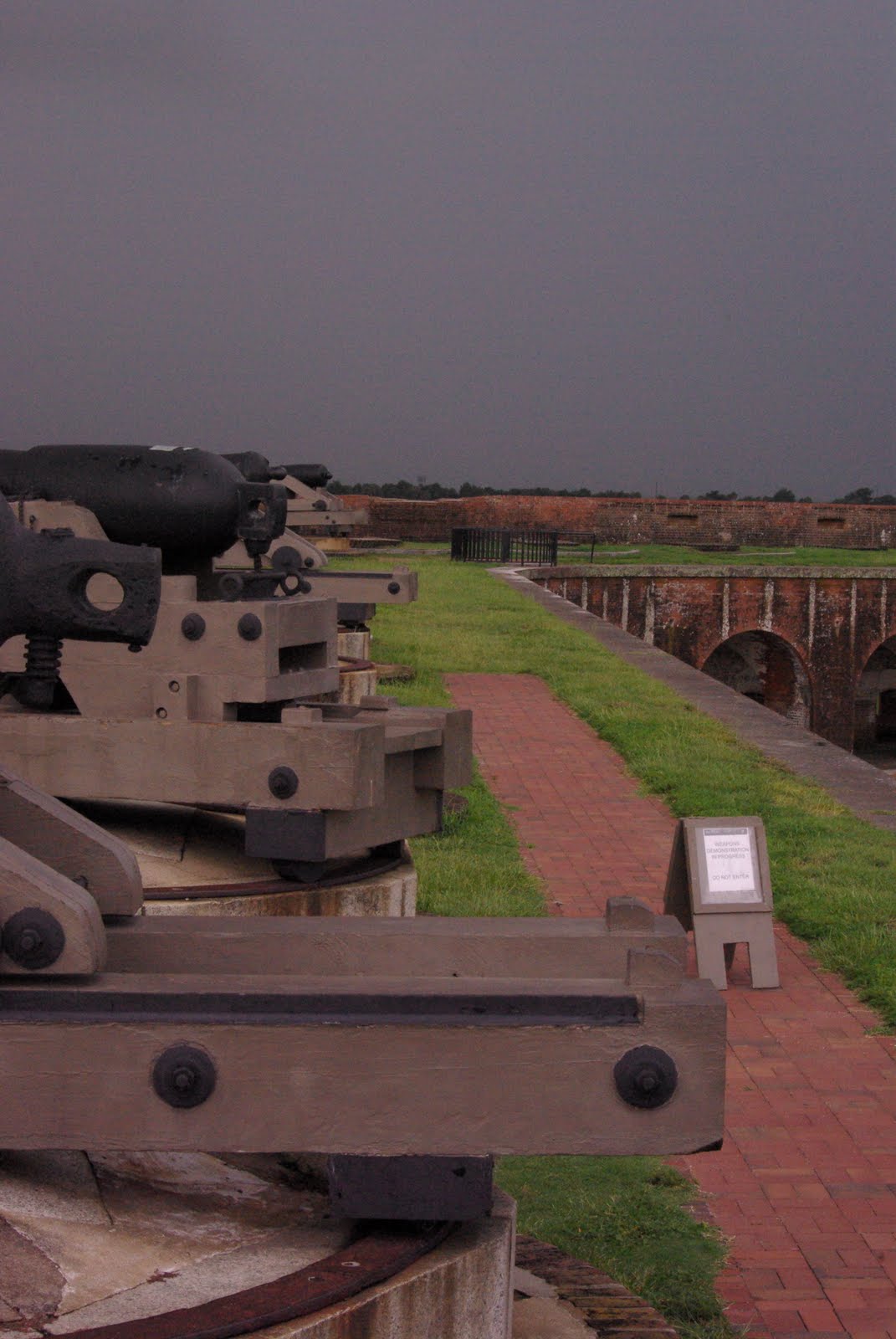
This morning I read about the items found at an archaeological site near Savannah, a Civil War POW camp abandoned just before Gen. Sherman reached the sea. Immediately I thought of some photos I took last year at Fort Pulaski, also near Savannah. The foreboding sky in some of them attests to the storm approaching the fort that afternoon; it imparted something of what the atmosphere may have felt like for those in the fort in the early days of the fighting. The fort was quiet the afternoon of our visit, almost church-like. While I am in no way an authority on the events and battles of that conflict I can say that I have noticed that same atmosphere at nearly all of the battlefields I and my family have visited over the years.

Enjoy the photos.

[[Photos: From top: Cannon atop Fort Pulaski, Barbara Butler McCoy, August 2010; Crossing the Moat at Fort Pulaski, Barbara Butler McCoy, August 2010; Walkway on top of Fort Pulaski, Barbara Butler McCoy, August 2010.]]

Thursday, August 18, 2011

Peace, Mardi


Thank you for sixteen-and-a-half fun and loving years, Mardi. We will always remember your beauty and sweetness.

[[Photo: Mardi McCoy, 1995-2011]]

Monday, August 8, 2011

Thirty Years


A lovely day for us today: my husband and I celebrate our 30th wedding anniversary.

Many people have remarked upon this milestone, and even we have moments when the scope of this leaves us a little dazed.

If I were to say anything about the longevity of a marriage I think it would be that the fabric of married life is much like the lace of my gauntlets in the photo. A couple works the threads of their lives into a pattern. Sometimes the pattern is a mystery to them, sometimes they see it readily. Sometimes the threads snarl or break. Sometimes their skill is evident, sometimes their clumsiness. Sometimes outside forces rip into their work, sometimes they tear it themselves.

Always, the best results come to those who believe, to paraphrase St. Paul, "Love always wins."

Happy Anniversary Gerry.

[[Photo: Newly-minted Mr. and Mrs. Gerald McCoy, St. James the Less Catholic Church, Columbus, Ohio, 1981]]

Saturday, July 30, 2011

Pardon Old Fathers


"Pardon old fathers" - that phrase came to mind as I wrote in my journal about a recent trip to Hendersonville, NC and environs with a dear friend at the end of June.

Why "Pardon old fathers"? As you can see, I was drawn to the charm of a few barns in various locations and the photos evoked memories of childhood visits to my grandparents Butler's home in rural Algonac, MI. An iconic big red barn stood on the property, near the garage, and Grandpa Butler very kindly and patiently would let me use the barn door as a target whenever I wanted to pretend I was an Indian huntress. (Remember, this is about 1964 ...)


So, the barns at Connemara Dairy Farm on the grounds of the poet Carl Sandburg's last home, a National Historic Site
in Flat Rock, NC, and on the road to the Yummy Mud Puddle studio of Claudia Dunaway and John Richards gave me the chance to 'shoot' barns once again, with less damage.

While not technically a barn the personality of Shawn Ireland's shop, near his kilns, just made me smile. My friend purchased a gorgeous bowl as an early birthday present for me, which I use nearly every morning as my teacup.
My friend and I covered quite a few miles - even climbed to Chimney Rock and Hickory Nut Falls - in our three-day- stay in the area, and rested a spell on the grounds of the Penland School our last afternoon. I haven't been able nor do I ever hope to forget the graciousness and talent of all the artists we met, the stunning beauty of all the artwork, the delicious food at locally owned restaurants, and the breathtaking natural beauty of the Blue Ridge Mountains.

Last year I initiated an experiment wherein I sought out alternative sources for Christmas gifts for my loved ones and friends. Some of the gifts I made myself (paintings, photos, clothing I sewed myself) and some came from places like the Spruill Gallery in nearby Dunwoody. So, on this short trip I was quite happy to get a start on some of my alternative Christmas shopping for this year there in the shops and galleries.

Too, the visit has inspired me to try new methods and materials, so this
Christmas should be interesting!

Since I am posting all these photos of barns I thought the stunning anthropomorphic paper rooster who rules over The Well Bred Bakery deserved a space in this gallery!

[[Photos: Top, Water Trough at Connemara Farms Dairy, Barbara Butler McCoy, June 2011; Second, On the Way to Yummy Mud Puddle, Barbara Butler McCoy, June 2011; Third, Shawn Ireland Pottery Shop, Barbara Butler McCoy, June 2011; Bottom, Paper Rooster on the Mantel, Barbara Butler McCoy, June 2011]]

Wednesday, May 11, 2011

"Such Shaping Fantasies: Dali, Shakespeare, Juliet - Madmen All"


"Lovers and madmen have such seething brains,
Such shaping fantasies, that apprehend
More than cool reason ever comprehends.
The lunatic, the lover, and the poet
Are of imagination all compact.

William Shakespeare, "A Midsummer Night's Dream," V. i. 4-8

Today's date marks the birthday of Salvador Dali (1904-1989), an artist with "such [a] seething brain[-s] whose images and antics many, many people have described as 'crazy.' I make no claim whatsoever to judge the state of his mental health. Upon contemplation and a beginning study of some of his work, however, I see Dali as one who may well fit the role of "lunatic" in that trio.

While I feel that Will Shakespeare wanted the public to consider his 'Juliet' to be primarily a lover and himself a poet, those identities belong to both of them. As I showed in my last post 'Juliet'/the Dark Lady and 'Romeo'/Will Shakespeare are both themselves and 'the other,' a concept Andre Breton, the acknowledged founder of Surrealism, might very well recognize as "L'un dans l'autre," the one in the other. (Yet, in May 1926 Joan Miro and Max Ernst were excommunicated by the Surrealists for working on a production of the 'bourgeois' ballet of "Romeo and Juliet.")

Of note here and now is this: given that Romeo is referred to as a madman numerous times throughout the play, these lovers and poets are also lunatics. Yes. Salvador Dali, William Shakespeare, and 'Juliet' - lunatics all.

Salvador Dali had been aligned for some years with the group calling themselves Surrealists, led by Andre Breton, who considered the surreal to be "a dialogue with the other with what is encountered by way of dreams, coincidences, correspondences, the marvelous, the uncanny; a reciprocal exchange, connecting conscious and unconscious thought) ..." (Caws, Mary Ann; "Surrealism")

We are to understand that when a chance encounter with this 'other' arouses wonder in us, we have experienced the surreal. The Surrealists held that the only bounds keeping us from an experience of this wonder, of the surreal, are those bounds "which are self-imposed by the limitations of our own imagination and its verbal and visual expression." (Caws, Mary Ann; "Surrealism")

William Shakespeare, as our poet, manages to describe quite eloquently and fantastically just such an encounter with the marvelous, as well as the limitations of expressing that experience, when he has Bottom theWeaver paraphrase the Pauline test of I Corinthians 2:9 (KJV) in the following manner: "The eye of man hath not heard, the ear of man hath not seen, man's hand is not able to taste, his tongue to conceive, nor his heart to report what my dream was." ("A Midsummer Night's Dream," IV. i. 220-224)

What sets the lunatic, the lover, and the poet apart from, shall I say, the more bound, is that they have realized, each one, that they must transcend their self-imposed bonds to begin to have a dialogue with the wonderful, with the marvelous, let alone begin to translate this for others.

The ripple effect of the artist translating his or her dialogue with the other is seen again in the work of Akira Kurosawa, specifically his film "Dreams" (1990). Some dream sequences seem to be Kurosawa's attempt to translate his heart's report of a nuclear disaster, which blends Shakespeare's contemplation of dreams and Dali's contemplation of uncertainty in the nuclear age.

'Juliet' and Will Shakespeare found guidance for sustaining a dialogue with the other in the Lucan text (Luke 17:33) asserting that to lose your life is to keep it safe. Andre Breton, thus Surrealism, asserted the need to 'Leave everything.' He wrote in 'Les Pas perdus' ('The Lost Footsteps'), " ... Leave your hopes and fears ... Leave the substance for the shadow. Leave your easy life, leave what you are given for the future. Set off on the roads." (Caws, Mary Ann; "Surrealism")

Examine everything. Closely. If it needs shaking, shake it up. If it needs breaking, break it up. Should the probability that everything you know of your life then fall to pieces and land in fragments at your feet, turn to the marvelous, the wondrous, the magnificently dreamy. Follow "Such shaping fantasies, that apprehend/More than cool reason ever comprehends."

In my contemplation of certain pieces of Dali's late work, I see, I believe, that Salvador Dali and William Shakespeare saw much the same fantasies shaping the fragments at their feet: their loves, a feminine deity. Dali repeatedly offered up tantalizing and paradoxical images of Madonnas in his late work - "Cosmic (Exploding) Madonna," "Corpuscular Madonna," Maximum Speed of Raphael's Madonna," "Madonna of Port Ligat, first version (from the collection of Marquette University, my alma mater), and the final version of "Madonna of Port Ligat."

To my eye they appear in an uncertain state. Have they been blown apart or are thy pulling themselves together? This uncertainty could reflect Dali's fascination with Werner Heisenber's Uncertainty Principle: "It shows that a particle can't have both a precise position and precise momentum at the same time." (Siegried, Tom; "Strange Matters")

Dali felt strongly that humanity needed a vision to guide it through the nuclear age ushered in in the mid-1940s. These Madonnas are significant in my view because they are the vision he found when he slipped any bonds upon his imagination.

I now propose that 350 years before Dali's imagination and brushes and tints gave us his Madonnas, William Shakespeare gave us a constellation of images of a feminine deity, a constellation that formed after repeated encounters with the 'other,' the 'marvelous.' In the case of 'Juliet" that feminine deity is the ancient goddess Isis.

It is said Isis and Osiris were twins who fell in love in the womb and married after birth. Osiris's wicked brother Seth lures him to a beautiful wooden chest, traps him in it, and throws it into a river. Isis wanders the world in despair asking everyone if they have seen Osiris's chest, which has become incorporated into a pillar in the house of the king of Byblos. Isis gains a position in the king's household as a nurse. Every night she transforms herself into a swallow and flies about the pillar, crying. When she reveals the truth to the king she asks to be given the pillar.

"Having been given the chest, she takes it to a secluded place, opens it, and caresses the body of Osiris. By means of her great magical power and strong affection, Isis is able to revive Osiris's penis." The child Horus is conceived, but he is born prematurely and with weak lower limbs. "Throughout his infancy, when he was a weakling, Horus had been patiently nourished and protected by Isis until he was able to assume mature strength and defeat Seth, " (Kinsley, David; "The Goddesses' Mirror") who after his birth had reappeared, stolen Osiris's body, dismembered it and scattered the fragments.

I identify three significant elements of the story of Isis and Osiris in "Romeo and Juliet" : the Nurse, the grave/wedding bed imagery, and the fragments of a self imagery. The character of the Nurse, I confess, has always been a problem for me. Conventional wisdom has held her presence to be a bit of the sage and much of the clown, but that does not quite fit in my mind. Isis' identity as a nurse in the court of the king of Byblos is a step in the proper direction. In the context of this post I would have to say that I still have uncertainty about her.

I do note that in her rambling discourse of 'Juliet's' childhood she speaks of it as it relates in time to an earthquake, a shaking of the earth. 'Juliet,' this beauty, making the globe quake? Could that have been?

The Nurse also reinforces the aspect of a fragmented self, a tenet of Surrealism, as introduced by 'Juliet' in her iconic "Wherefore art thou Romeo?" musing. Three scenes after this we hear the Nurse describe Romeo: "Though his face be better than any man's, yet his leg excels all men's, and for a hand and a foot and a body, though they be not to be talked on, yet they are past compare." While Will Shakespeare intended a Pauline context for those lines, I feel he also intended to evoke the story of Osiris's dismemberment by Seth. ('Swordsmanship' with the word 'prick' indicates, however, that Romeo, unlike Osiris, has his genitals.)

The prevailing imagery evoking Isis and Osiris in "Romeo and Juliet," however, is that of the "womb of death" (V.iii.45). The imagery is present throughout the play, alluded to most famously at the close of the first act when 'Juliet' says, "If he be married, My grave is like to be my wedding bed." In the third act, after their wedding night and before Romeo departs for Mantua, 'Juliet' seem
s to see him, in her mind, as if he is in a tomb.

The most striking and explicit evocation of the Isis and Osiris story is spoken by Romeo in the fifth act as he waits in Mantua for news of 'Juliet': "If I may trust the flattering truth of sleep ..... I dreamt my lady came and found me dead/(Strange dream that gives a dead man leave to think!)/And breathed such life with kisses in my lips/That I revived and was an emperor."

The feminine reviving the fragmented self.

Many scholars over time have noted the parallels between the iconography of Horus seated on the lap of Isis and the infant Jesus seated on the lap of the Madonna. I note that just as an image of a feminine deity emerges onto the world stage in a constellation of plays from Will Shakespeare's imagination, serving a world in turmoil, I see the possibility of an image of the Madonna emerging from the fragments Salvador Dali placed so carefully on his canvases.

I cannot shake the sense that, although he had parted ways with the Surrealists years earlier, Dali could not divorce himself from the Surrealist tenet that Beauty, the wondrous, the marvelous, would indeed convulse, shake up, explode into the world. William Shakespeare envisioned it in his world. Dali envisioned it in his as well.

The fragments are there, that is certain, and we see these artists' work to guide us.

[Bibliography: Caws, Mary Ann (ed.). "Surrealism." Phaidon Publishers, Inc., Published 2010; Kinsley, David. "the Goddesses' Mirror: Visions of the Divine from East and West." Albany: SUNY Press, c. 1989; Shakespeare, William. "A Midsummer Night's Dream." New York: Washington Square Press, c. 1993; Shakespeare, William. "Romeo and Juliet." New York: Washington Square Press, c. 1992; Siegried, Tom. "Strange Matters: Undiscovered Ideas at the Frontiers of Space and Time." New York: Berkley Books, c. 2002]

[[Photos, all Barbara Butler McCoy: Top - Statue of Anubis, Atlanta, 2009; Middle - Sign outside the Folger Shakespeare Library, 2009; Bottom - Relief of "Romeo and Juliet" on the Folger Shakespeare Library, 2009]]