Monday, October 17, 2011

Moving


It's been a little over three years since I started this blog and I think it's time for a fresh face, don't you? Given that, and after looking around a bit, I decided to start the process by moving over to WordPress. I even have a new 'name,' inspired by my latest post about Will Shakespeare and his 'Juliet': solesisterjuliet.wordpress.com. This is just the beginning (again ;0) but I think it will be fun. I am still tweaking the page over there, so bear with me, okay? I'll give alerts here about posts on the Sole Sister site for awhile, but I hope you record the new address as THE address. See you there!

Friday, September 9, 2011

In Her Shoes

STILETTO, a dagger developed in southern Europe and in common use in the 16th century. It had a slender blade about six inches (15cm) long that tapered to a sharp point. Employed only as a stabbing weapon, the stiletto's blade had no cutting edge, but was three- or four-sided to give it firmness and strength. Some stilettos were sturdy enough to penetrate light armor, and some were so small and light that they could be used by a woman. The stiletto's handle was protected by a simple cross guard, or quillon. [Encyclopedia Americana, c. 1980 Americana Corporation.]


In my fashion I was thinking of the Twelve Dancing Princesses so I thought I'd rework a composition in acrylics I'd sent off last Christmas as a gift - some shoes in vibrant hues, hues with a 60s vibe. As I worked with the sketches and colors I heard over and over in my mind, "Why, then is my pump well flowered."

Why was the Creative Voice directing me to "Romeo and Juliet" as I painted fanciful shoes? Was it just that women's high heels are also called pumps? Repeatedly, in my mind, I circled around the prompt of Romeo and pumps, closer and closer until I finally hit the mark: heels, pumps, stilettos. Then: stiletto, dagger, Juliet. On the heels of that revelation came the epiphany that the stiletto, a type of dagger, was Will Shakespeare's incredibly elegant and compact icon describing much about his 'Juliet,' his 'Dark Lady.'

Previously I posited that Juliet's manner of death, stabbing herself with a dagger, was actually a dramatization of the Lucan paradox (Luke 17:33), "Whoever seeks to save his life will lose it, and whoever loses his life will preserve it." This woman had chosen to take her life in her own hands. She would guide her destiny.

It is worth exploring now the wider significance with which the playwright imbued the stiletto. Given the references in the play to soles and pumps I believe Will Shakespeare is telling us that his love, his 'Juliet,' his 'Dark Lady' took her financial welfare in her own hands as well and was, in some way, associated with shoemakers, or 'cordwainers' as they have been called for centuries.

My research of the Cordwainers turned up at least two facts I find most interesting and pertinent to this discussion. It is significant to note that the Worshipful Company of Cordwainers is and was located in Cheapside in London - just a ten minute or so walk from the Globe Theater.

Another fact, to which the playwright may be alluding when the Nurse indicates that whoever marries 'Juliet' will have 'the chinks,' is that Henry VI granted the guild a Royal Charter in 1439. A Royal Charter was an important and positive development for a business then, as I believe it is now. This charter likely means that the Company of Cordwainers were shoemakers to the monarchy.

It would be interesting to know the 'Dark Lady's' exact association with the cordwainers. Did she own a shop? Did she herself make shoes? Perhaps she designed them? Unfortunately, there is a very slim chance anything can be learned from the company's records because in 1666 the original hall burned down and most of the records were lost.

The longer I consider the dominant revelation that 'Juliet' took control of her own life by use of a stiletto, a stiletto Shakespeare also wants us to know is a shoe, I find myself wondering if the 'Dark Lady' felt compelled, even at a young age, to fashion for herself a pair of shoes that in some way used actual stilettos as heels. If so, why?

Why would a young girl - a girl barely a teenager and a bookworm, if I read Lady Capulet's lines aright; a girl ardently sought as a bride; a girl Romeo describes as "Beauty too rich for use, for earth too dear" - feel it necessary to include stilettos in the fashion of her shoes?

I can only surmise that her beauty, financial wealth, and elevated social status (perhaps nobility) were threats to her welfare at times. Her choice of a stiletto tells me she absolutely meant to defend herself should she find herself cornered, backed against a wall. It would be a close, dangerous fight, but fight she would. Further, if she was of noble birth, her beauty would likely have been known to the court. She may often have been present at court. Those stilettos would have served as a distinctly unquestionable warning to any lotharios. You'd best watch your step when you dance with a woman wearing those shoes.

This focus on 'Juliet's' shoes fleshes out for us the relationship between herself and Romeo, the 'Dark Lady' and Will Shakespeare. When 'Juliet' muses, "What's Montague? It is nor hand, nor foot," perhaps the line references the son of the glover and the shoemaker? Romeo's line in Act II Scene iv, "Why, then is my pump well flowered," gives us a much more intimate look at the relationship between the playwright and the Beauty. In addition to the sexual connotation I believe it tells us that Will Shakespeare wore shoes from the 'Dark Lady's' shop. Perhaps they also were 'too rich for use' and 'too dear' to be worn on other than grand court occasions?

Beyond that, however, I believe Will Shakespeare was dramatizing for us his theme of "the marriage of true minds." I have written elsewhere that the playwright was presenting the 'Dark Lady' to us as a figure embodying love, compassion, mercy and enlightenment, someone committed to and involved with all living and suffering. When Will Shakespeare tells us he wore 'Juliet's' shoes he is is telling us that like the 'Dark Lady' he puts himself in the shoes of others and walks the path of compassion in hope of guiding others to enlightenment.

Does he not use the language of heavenly bodies of light, the Sun and the stars, to characterize Romeo and Juliet? It is not hard to imagine that he caught the double meaning of 'sun' in Spanish, el Sol, and the sole of a shoe!

The playwright characterizes this facet of their relationship upon this path in "A Midsummer Night's Dream" as being "of imagination all compact." Both lovers, crazy perhaps for their imaginings, were poets, their hands composing feet into verses out of respect for and commitment to humanity.

Will Shakespeare used the trend for exaggerated heel height to characterize his 'Juliet's' elevated consciousness. I greatly appreciate their commitment to compassion as more than a 'fashion.'

Friday, August 26, 2011

Anticipation


It is Friday today and it is my 52nd birthday. When I consider all that has come before, and all that is to come, I can only say that every moment, every choice was part of a Now. My fervent wish, whether on my birthday or not, is to stay in each moment and see it for its Beauty.

Now I would like to share some of my favorite quotes relating to Beauty.

First, as you would expect, there is Romeo's description of his Juliet: "Beauty too rich for use, for earth too dear." ("Romeo and Juliet," William Shakespeare, I.iii. 54)

I admire also Keats's immortal lines from "Ode on a Grecian Urn": "Beauty is truth, Truth beauty/ That is all ye know on earth and all ye need to know."

There is a portion of the midday Canticle in the Celtic Daily Prayer from the Northumbrian Community I find quite lovely: "Teach us, dear Lord, to number our days/ That we may apply our hearts unto wisdom./Oh, satisfy us early with Thy mercy/That we may rejoice and be glad all of our days./And let the Beauty of the Lord our God be upon us/And establish the work of our hands."

Finally, a quote from Brian Andreas at Storypeople.com : "She said she usually cried at least once each day not because she was sad, but because the world was so beautiful and life was so short."

[[Photo: Lily in the Morning Light, Barbara Butler McCoy, August 2011.]]

Friday, August 19, 2011

Georgia and the Civil War


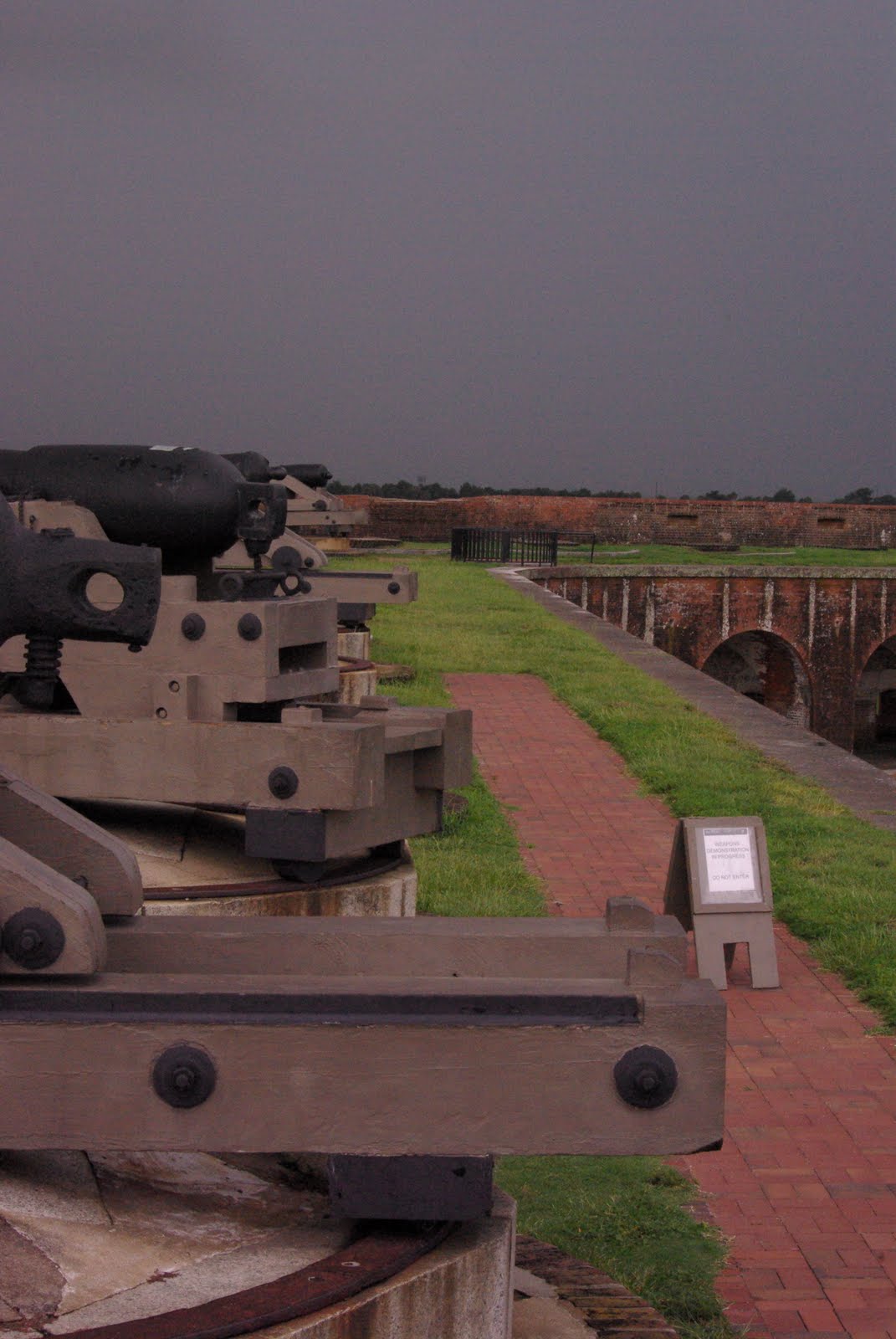
This morning I read about the items found at an archaeological site near Savannah, a Civil War POW camp abandoned just before Gen. Sherman reached the sea. Immediately I thought of some photos I took last year at Fort Pulaski, also near Savannah. The foreboding sky in some of them attests to the storm approaching the fort that afternoon; it imparted something of what the atmosphere may have felt like for those in the fort in the early days of the fighting. The fort was quiet the afternoon of our visit, almost church-like. While I am in no way an authority on the events and battles of that conflict I can say that I have noticed that same atmosphere at nearly all of the battlefields I and my family have visited over the years.

Enjoy the photos.

[[Photos: From top: Cannon atop Fort Pulaski, Barbara Butler McCoy, August 2010; Crossing the Moat at Fort Pulaski, Barbara Butler McCoy, August 2010; Walkway on top of Fort Pulaski, Barbara Butler McCoy, August 2010.]]

Thursday, August 18, 2011

Peace, Mardi


Thank you for sixteen-and-a-half fun and loving years, Mardi. We will always remember your beauty and sweetness.

[[Photo: Mardi McCoy, 1995-2011]]

Monday, August 8, 2011

Thirty Years


A lovely day for us today: my husband and I celebrate our 30th wedding anniversary.

Many people have remarked upon this milestone, and even we have moments when the scope of this leaves us a little dazed.

If I were to say anything about the longevity of a marriage I think it would be that the fabric of married life is much like the lace of my gauntlets in the photo. A couple works the threads of their lives into a pattern. Sometimes the pattern is a mystery to them, sometimes they see it readily. Sometimes the threads snarl or break. Sometimes their skill is evident, sometimes their clumsiness. Sometimes outside forces rip into their work, sometimes they tear it themselves.

Always, the best results come to those who believe, to paraphrase St. Paul, "Love always wins."

Happy Anniversary Gerry.

[[Photo: Newly-minted Mr. and Mrs. Gerald McCoy, St. James the Less Catholic Church, Columbus, Ohio, 1981]]

Saturday, July 30, 2011

Pardon Old Fathers


"Pardon old fathers" - that phrase came to mind as I wrote in my journal about a recent trip to Hendersonville, NC and environs with a dear friend at the end of June.

Why "Pardon old fathers"? As you can see, I was drawn to the charm of a few barns in various locations and the photos evoked memories of childhood visits to my grandparents Butler's home in rural Algonac, MI. An iconic big red barn stood on the property, near the garage, and Grandpa Butler very kindly and patiently would let me use the barn door as a target whenever I wanted to pretend I was an Indian huntress. (Remember, this is about 1964 ...)


So, the barns at Connemara Dairy Farm on the grounds of the poet Carl Sandburg's last home, a National Historic Site
in Flat Rock, NC, and on the road to the Yummy Mud Puddle studio of Claudia Dunaway and John Richards gave me the chance to 'shoot' barns once again, with less damage.

While not technically a barn the personality of Shawn Ireland's shop, near his kilns, just made me smile. My friend purchased a gorgeous bowl as an early birthday present for me, which I use nearly every morning as my teacup.
My friend and I covered quite a few miles - even climbed to Chimney Rock and Hickory Nut Falls - in our three-day- stay in the area, and rested a spell on the grounds of the Penland School our last afternoon. I haven't been able nor do I ever hope to forget the graciousness and talent of all the artists we met, the stunning beauty of all the artwork, the delicious food at locally owned restaurants, and the breathtaking natural beauty of the Blue Ridge Mountains.

Last year I initiated an experiment wherein I sought out alternative sources for Christmas gifts for my loved ones and friends. Some of the gifts I made myself (paintings, photos, clothing I sewed myself) and some came from places like the Spruill Gallery in nearby Dunwoody. So, on this short trip I was quite happy to get a start on some of my alternative Christmas shopping for this year there in the shops and galleries.

Too, the visit has inspired me to try new methods and materials, so this
Christmas should be interesting!

Since I am posting all these photos of barns I thought the stunning anthropomorphic paper rooster who rules over The Well Bred Bakery deserved a space in this gallery!

[[Photos: Top, Water Trough at Connemara Farms Dairy, Barbara Butler McCoy, June 2011; Second, On the Way to Yummy Mud Puddle, Barbara Butler McCoy, June 2011; Third, Shawn Ireland Pottery Shop, Barbara Butler McCoy, June 2011; Bottom, Paper Rooster on the Mantel, Barbara Butler McCoy, June 2011]]

Wednesday, May 11, 2011

"Such Shaping Fantasies: Dali, Shakespeare, Juliet - Madmen All"


"Lovers and madmen have such seething brains,
Such shaping fantasies, that apprehend
More than cool reason ever comprehends.
The lunatic, the lover, and the poet
Are of imagination all compact.

William Shakespeare, "A Midsummer Night's Dream," V. i. 4-8

Today's date marks the birthday of Salvador Dali (1904-1989), an artist with "such [a] seething brain[-s] whose images and antics many, many people have described as 'crazy.' I make no claim whatsoever to judge the state of his mental health. Upon contemplation and a beginning study of some of his work, however, I see Dali as one who may well fit the role of "lunatic" in that trio.

While I feel that Will Shakespeare wanted the public to consider his 'Juliet' to be primarily a lover and himself a poet, those identities belong to both of them. As I showed in my last post 'Juliet'/the Dark Lady and 'Romeo'/Will Shakespeare are both themselves and 'the other,' a concept Andre Breton, the acknowledged founder of Surrealism, might very well recognize as "L'un dans l'autre," the one in the other. (Yet, in May 1926 Joan Miro and Max Ernst were excommunicated by the Surrealists for working on a production of the 'bourgeois' ballet of "Romeo and Juliet.")

Of note here and now is this: given that Romeo is referred to as a madman numerous times throughout the play, these lovers and poets are also lunatics. Yes. Salvador Dali, William Shakespeare, and 'Juliet' - lunatics all.

Salvador Dali had been aligned for some years with the group calling themselves Surrealists, led by Andre Breton, who considered the surreal to be "a dialogue with the other with what is encountered by way of dreams, coincidences, correspondences, the marvelous, the uncanny; a reciprocal exchange, connecting conscious and unconscious thought) ..." (Caws, Mary Ann; "Surrealism")

We are to understand that when a chance encounter with this 'other' arouses wonder in us, we have experienced the surreal. The Surrealists held that the only bounds keeping us from an experience of this wonder, of the surreal, are those bounds "which are self-imposed by the limitations of our own imagination and its verbal and visual expression." (Caws, Mary Ann; "Surrealism")

William Shakespeare, as our poet, manages to describe quite eloquently and fantastically just such an encounter with the marvelous, as well as the limitations of expressing that experience, when he has Bottom theWeaver paraphrase the Pauline test of I Corinthians 2:9 (KJV) in the following manner: "The eye of man hath not heard, the ear of man hath not seen, man's hand is not able to taste, his tongue to conceive, nor his heart to report what my dream was." ("A Midsummer Night's Dream," IV. i. 220-224)

What sets the lunatic, the lover, and the poet apart from, shall I say, the more bound, is that they have realized, each one, that they must transcend their self-imposed bonds to begin to have a dialogue with the wonderful, with the marvelous, let alone begin to translate this for others.

The ripple effect of the artist translating his or her dialogue with the other is seen again in the work of Akira Kurosawa, specifically his film "Dreams" (1990). Some dream sequences seem to be Kurosawa's attempt to translate his heart's report of a nuclear disaster, which blends Shakespeare's contemplation of dreams and Dali's contemplation of uncertainty in the nuclear age.

'Juliet' and Will Shakespeare found guidance for sustaining a dialogue with the other in the Lucan text (Luke 17:33) asserting that to lose your life is to keep it safe. Andre Breton, thus Surrealism, asserted the need to 'Leave everything.' He wrote in 'Les Pas perdus' ('The Lost Footsteps'), " ... Leave your hopes and fears ... Leave the substance for the shadow. Leave your easy life, leave what you are given for the future. Set off on the roads." (Caws, Mary Ann; "Surrealism")

Examine everything. Closely. If it needs shaking, shake it up. If it needs breaking, break it up. Should the probability that everything you know of your life then fall to pieces and land in fragments at your feet, turn to the marvelous, the wondrous, the magnificently dreamy. Follow "Such shaping fantasies, that apprehend/More than cool reason ever comprehends."

In my contemplation of certain pieces of Dali's late work, I see, I believe, that Salvador Dali and William Shakespeare saw much the same fantasies shaping the fragments at their feet: their loves, a feminine deity. Dali repeatedly offered up tantalizing and paradoxical images of Madonnas in his late work - "Cosmic (Exploding) Madonna," "Corpuscular Madonna," Maximum Speed of Raphael's Madonna," "Madonna of Port Ligat, first version (from the collection of Marquette University, my alma mater), and the final version of "Madonna of Port Ligat."

To my eye they appear in an uncertain state. Have they been blown apart or are thy pulling themselves together? This uncertainty could reflect Dali's fascination with Werner Heisenber's Uncertainty Principle: "It shows that a particle can't have both a precise position and precise momentum at the same time." (Siegried, Tom; "Strange Matters")

Dali felt strongly that humanity needed a vision to guide it through the nuclear age ushered in in the mid-1940s. These Madonnas are significant in my view because they are the vision he found when he slipped any bonds upon his imagination.

I now propose that 350 years before Dali's imagination and brushes and tints gave us his Madonnas, William Shakespeare gave us a constellation of images of a feminine deity, a constellation that formed after repeated encounters with the 'other,' the 'marvelous.' In the case of 'Juliet" that feminine deity is the ancient goddess Isis.

It is said Isis and Osiris were twins who fell in love in the womb and married after birth. Osiris's wicked brother Seth lures him to a beautiful wooden chest, traps him in it, and throws it into a river. Isis wanders the world in despair asking everyone if they have seen Osiris's chest, which has become incorporated into a pillar in the house of the king of Byblos. Isis gains a position in the king's household as a nurse. Every night she transforms herself into a swallow and flies about the pillar, crying. When she reveals the truth to the king she asks to be given the pillar.

"Having been given the chest, she takes it to a secluded place, opens it, and caresses the body of Osiris. By means of her great magical power and strong affection, Isis is able to revive Osiris's penis." The child Horus is conceived, but he is born prematurely and with weak lower limbs. "Throughout his infancy, when he was a weakling, Horus had been patiently nourished and protected by Isis until he was able to assume mature strength and defeat Seth, " (Kinsley, David; "The Goddesses' Mirror") who after his birth had reappeared, stolen Osiris's body, dismembered it and scattered the fragments.

I identify three significant elements of the story of Isis and Osiris in "Romeo and Juliet" : the Nurse, the grave/wedding bed imagery, and the fragments of a self imagery. The character of the Nurse, I confess, has always been a problem for me. Conventional wisdom has held her presence to be a bit of the sage and much of the clown, but that does not quite fit in my mind. Isis' identity as a nurse in the court of the king of Byblos is a step in the proper direction. In the context of this post I would have to say that I still have uncertainty about her.

I do note that in her rambling discourse of 'Juliet's' childhood she speaks of it as it relates in time to an earthquake, a shaking of the earth. 'Juliet,' this beauty, making the globe quake? Could that have been?

The Nurse also reinforces the aspect of a fragmented self, a tenet of Surrealism, as introduced by 'Juliet' in her iconic "Wherefore art thou Romeo?" musing. Three scenes after this we hear the Nurse describe Romeo: "Though his face be better than any man's, yet his leg excels all men's, and for a hand and a foot and a body, though they be not to be talked on, yet they are past compare." While Will Shakespeare intended a Pauline context for those lines, I feel he also intended to evoke the story of Osiris's dismemberment by Seth. ('Swordsmanship' with the word 'prick' indicates, however, that Romeo, unlike Osiris, has his genitals.)

The prevailing imagery evoking Isis and Osiris in "Romeo and Juliet," however, is that of the "womb of death" (V.iii.45). The imagery is present throughout the play, alluded to most famously at the close of the first act when 'Juliet' says, "If he be married, My grave is like to be my wedding bed." In the third act, after their wedding night and before Romeo departs for Mantua, 'Juliet' seem
s to see him, in her mind, as if he is in a tomb.

The most striking and explicit evocation of the Isis and Osiris story is spoken by Romeo in the fifth act as he waits in Mantua for news of 'Juliet': "If I may trust the flattering truth of sleep ..... I dreamt my lady came and found me dead/(Strange dream that gives a dead man leave to think!)/And breathed such life with kisses in my lips/That I revived and was an emperor."

The feminine reviving the fragmented self.

Many scholars over time have noted the parallels between the iconography of Horus seated on the lap of Isis and the infant Jesus seated on the lap of the Madonna. I note that just as an image of a feminine deity emerges onto the world stage in a constellation of plays from Will Shakespeare's imagination, serving a world in turmoil, I see the possibility of an image of the Madonna emerging from the fragments Salvador Dali placed so carefully on his canvases.

I cannot shake the sense that, although he had parted ways with the Surrealists years earlier, Dali could not divorce himself from the Surrealist tenet that Beauty, the wondrous, the marvelous, would indeed convulse, shake up, explode into the world. William Shakespeare envisioned it in his world. Dali envisioned it in his as well.

The fragments are there, that is certain, and we see these artists' work to guide us.

[Bibliography: Caws, Mary Ann (ed.). "Surrealism." Phaidon Publishers, Inc., Published 2010; Kinsley, David. "the Goddesses' Mirror: Visions of the Divine from East and West." Albany: SUNY Press, c. 1989; Shakespeare, William. "A Midsummer Night's Dream." New York: Washington Square Press, c. 1993; Shakespeare, William. "Romeo and Juliet." New York: Washington Square Press, c. 1992; Siegried, Tom. "Strange Matters: Undiscovered Ideas at the Frontiers of Space and Time." New York: Berkley Books, c. 2002]

[[Photos, all Barbara Butler McCoy: Top - Statue of Anubis, Atlanta, 2009; Middle - Sign outside the Folger Shakespeare Library, 2009; Bottom - Relief of "Romeo and Juliet" on the Folger Shakespeare Library, 2009]]

Thursday, April 21, 2011

To Know William Shakespeare ...


The lunatic, the lover and the poet, at this point in the month of April, celebrate, honor and acknowledge the life and art of a man, William Shakespeare by name, whose impact upon Western literature and Western culture resonates more strongly year upon year. Shakespeare's art has also influenced culture in the East - witness the work of Akira Kurosawa.

In the West the phenomenon of the 'letters to Juliet' is a case in point for Shakespeare's influence. When I learned last year that a movie with that title was to be released I just shook my head. I figured the letters to Shakespeare's tragic fictional lover were meant to be only narrative devices to entice us. Not so.

I stumbled across a copy of the book of that title by Lise Friedman and Ceil Friedman and learned that letters to Juliet, all with love as their 'argument,' have been left at her tomb and mailed to the city of Verona, Italy for nearly 200 years. Veneration at a tomb reputed to be that of Juliet Capulet has, since early in the 19th century (early 1800s), attracted "an increasing number of pilgrims ... (Curiously, as the adoration of Juliet increased over time, Romeo's 'presence' was no longer required.)"

As I wrote previously, I believe Romeo to be William Shakespeare's alter ego, shall I say, so his presence is vital to an appreciation of Juliet's character and William Shakespeare himself. Some may ask why anyone cares anymore about "a pair of star-crossed lovers" who end their plight by taking their own lives. Many young women, in fact, dismiss Juliet for just that: "Kill yourself over a guy? That's just stupid."

As the centuries of veneration of and letters to Juliet attest, the story of these lovers has taken root in the world's imagination. Imagination has a vital influence upon one's heart and mind, thus whatever influences it deserves consideration and study. In this case the influence derives from the mind of William Shakespeare, of Stratford-upon-Avon. Yet what can we know of the presence which considered Juliet's model and crafted this character? Nearly 450 years after his birth William Shakespeare's life is cloaked more in mystery than buttressed by material evidence. We ask, to borrow from Yeats, "Those masterful images because complete/Grew in pure mind but out of what began?"

Quite simply I believe that Shakespeare gave us clues about himself in his art, most especially in "Romeo and Juliet." To begin this study, however, I turn to Sonnet #76 because in it the reader learns that Shakespeare's love, the Dark Lady, is the ALL of his art. His verse is "barren of new pride," "far from variation," and all his "best is dressing old words new." He states that "every word doth almost tell my name." "O, know, sweet love, I always write of you,/And you and love are still my argument."

Read his work, read him.

The couplet concluding the sonnet packs in some significant information: "For as the sun is daily new and old,/So is my love still telling what is told." That pair of words 'my love' signifies two subjects - his love as a state of mind and heart; his love as the object of his love who is, herself, "telling what is told." The allusion to the sun in the couplet points our attention to Juliet, the light breaking the darkness, and indicates to me that the play is as much about Romeo's/William Shakespeare's mind as hers.

In fact what emerges is a portrait of two lovers who have become one love. Know one, understand one of the lovers, and the other is known and understood. There is an intimation of this in the dialogue of each. "Two of the fairest stars in all the heaven/Having some business, do entreat her eyes/To twinkle in their spheres till they return." (Romeo and Juliet, II.ii.15-17) "Give me my Romeo, and when I shall die/ Take him and cut him out in little stars/And he will make the face of heaven so fine." (Romeo and Juliet, III.ii.22-25)

Together, wedded, they are heaven's light, sun and stars. Romeo is to Juliet a face of heaven so fine, so to speak, and Juliet is for Romeo "Beauty too rich for use, for earth too dear." Heavenly love, a beautiful life - right? Love, heaven, beauty - what could go wrong? Such dear, rich beauty of body and mind - why end it in suicide?

This is the challenge of the play, I think. It is not easy to see love die - until one realizes that the death, the suicide, is symbolic. The deaths of Romeo and Juliet are tragic, yes, but beyond that they are a dramatization of verse 33 of the gospel of Luke, chapter 17: "Whoever seeks to save his life will lose it, and whoever loses his life will preserve it." Romeo and Juliet take their lives IN their own hands, demonstrating theatrically this teaching.

The decision to take one's own life in one's own hand, to guide one's life by one's own compass, was quite daring for someone living in the repressive society of Tudor England. There were any number of entities vying for authority over the lives of others (church, state, family, spouse, guild, censor). Every would-be authority had its preconceived notions about what should be and was willing to enforce them. Transgressors were stigmatized, exiled, or executed.

The consequences of one's actions weighed heavily upon the mind even if the transgression was known only to oneself. It could be a bed of thorns, lying awake contemplating the regrets and anxieties of things done or not done, things said or not said. These two lovers, however, looked at what they truly were, not merely at their regrets or at what others held they should be.

As I wrote previously, Shakespeare portrayed his love, Romeo's Juliet, as living at a higher level of consciousness than he lived when they met. He learned of his Self, in part, from her, and I think we see evidence of her tuition in some of Juliet's lines, which echo some verses from St. Paul's first epistle to the Corinthians. Compare, "Thou art thyself, though not a Montague./What's Montague? It is nor hand, nor foot,/Nor arm, nor face, nor any other part/Belonging to a man," (Romeo and Juliet, II.ii.42-45) with, "For as the body is one and has many members, but all the members of that one body, being many, are one body, so also is Christ." ... "If the foot should say, 'Because I am not a hand, I am not of the body,' is it therefore not of the body?" (I Corinthians 12: 12, 15)

His love's singular point to William Shakespeare, as I see it, is that one aspect of one's self, one's experience, does not constitute the whole Self.

Shakespeare's allusion to this chapter of First Corinthians sheds light on the character of Juliet's Nurse and her influence in the girl's life. Verse 13 of I Cor. 12 instructs that all have "been made to drink into one Spirit." I feel strongly that it is that drinking of the one Spirit that Shakespeare intends us to understand in the Nurse's discourse (I.iii.18-53) about nursing Juliet as a babe.

As a babe Juliet, the Dark Lady, was fed upon the Spirit and grew with its nourishment into the woman who came to love William Shakespeare. Again, I Corinthians influences Will's art in offering an image of this nourishment and learning: "And I, brethren, could not speak unto you as unto spiritual, but as unto carnal, even as unto babes in Christ. I have fed you with milk, and not with meat: for hitherto ye were not able to bear it, neither yet now are ye able."

Juliet learned, as did Shakespeare, to examine all they had ever learned about themselves, all their 'methoughts,' to use some lines from Nick Bottom, the Weaver in "A Midsummer Night's Dream": "Methought I was -- there is no man can tell what. Methought I was and methought I had -- but man is a patched fool if he will offer to say what methought I had."

That reference to "a patched fool" calls to mind another teaching from the gospel of Luke, 5:36: "Then He spoke a parable to them: 'No one puts a piece from a new garment on an old one; otherwise the new makes a tear, and also the piece that was taken out of the new does not match the old.'" Romeo/Will, it seems, looked at all the 'methoughts' he'd learned to apply to himself and realized, "Tut, I have lost myself. I am not here./This is not Romeo. He's some other where." (I.i.205-6) Juliet illumined his life and mind and he understood he needed a new garment of Self, not some foolish patch job that would disintegrate.

So, in what spirit does one reconceive one's concept of Self? As Juliet and love are all his argument he constantly thinks on truth and beauty because the Dark Lady, still telling what is told, taught him according to Philippians 4:8: "Finally, brethren, whatsoever things are true, whatsoever things are honest, whatsoever things are just, whatsoever things are pure, whatsoever things are lovely, whatsoever things are of good report; if there by any virtue, and if there be any praise, think on these things."

They each considered these things and forged for themselves a 'marriage of true minds.' Romeo alludes to this when he says, in effect, that Juliet's eyes are stars. She sees as he sees, he sees as she sees.
In "Romeo and Juliet" we glimpse Juliet as a babe even as we see her as a teen. Further, as I
think the Dark Lady was approximately the same age as William Shakespeare, and that she was known to the theater crowd, I sense he wrote the part of Juliet at the behest of that crowd. I also sense he wanted the crowd to see Juliet and think of this verse, Philippians 4:9: "Those things, which ye have both learned, and received, and heard, and seen in me (Juliet) do: and the God of peace shall be with you."

I have come to see this play as being existential, just as "Hamlet" is. Yet, lest we feel Juliet's death was an unnecessary end consider, please, Luke 8:52-55, the story of the daughter of the ruler of the synagogue, thought to be dead: "Now all wept and mourned for her; but He said, 'Do not weep; she is not dead, but sleeping.' And they laughed Him to scorn, knowing that she was dead. But he put them all out, took her by the hand and called, saying, 'Little girl, arise.' Then her spirit returned, and she arose immediately. And he commanded that she be given something to eat."

[[Scripture verses: Luke 33:17 NKJV, Luke 5:36 NKJV, Luke 8:52-55 NKJV; I Corinthians 12, 12, 15 KJV, I Corinthians 12:13 KJV, I Corinthians 3:1-2 KJV, Philippians 4:8 KJV, Philippians 4:9 KJV. As I understand it, the King James Bible is the closest to the Geneva Bible, which was in use for much of Shakespeare's life.]]

[[Bibliography: Friedman, Lise. Friedman, Ceil. "Letters to Juliet." New York: Stewart, Tabori & Chang, 2006.

Yeats, William Butler. "The Collected Poems of William Butler Yeats (Richard J. Finneran, ed.)." New York: Simon & Schuster, Inc., 1996.

All references to Shakespeare's plays are to those published by the Folger Shakespeare Library, Washington, D.C.]]

[[Photos: Top - Homemade birthday cake for my son, April, 2011; Middle - the Sun on my courtyard wall, April, 2011; Bottom - roses in a McCoy pitcher, 2011 (all by Barbara Butler McCoy)]]


Tuesday, March 22, 2011

World Water Day 2011


"Let your life lightly dance on the edges of time
like dew on the tip of a leaf."

Sir Rabindranath Tagore

[[Photo:
Dew on a hosta leaf, May 2008,
Barbara Butler McCoy]]


Saturday, January 15, 2011

Chillin' Out


A bunch of flakes decided to combine their weight and drift into town with their wintery brand of chaos.

I've lived in Ohio, New York, Connecticut, and Wisconsin, among other places, so I am no stranger to winter weather. This feels pretty nice, in fact, especially since I've shaken the stomach bug that beset me in the middle of the night of the 8th, about 24 hours before the snow began to fall.

Life in this city is beginning to revive. I cannot almost hear the gears turning, looking for their rhythm.

I stepped out of my house several days after first snowfall and found these images.
[[Photos: My house, 01/12/11, Barbara Butler McCoy; Ice on the Street, 01/12/11, Barbara Butler McCoy; Sky on the Street, 01/12/11, Barbara Butler McCoy]]

Wednesday, December 8, 2010

On the Beach


On Thanksgiving Eve, before the arrival of dear friends and the 'Super Bowl of Cooking,' I wandered out into the ferocious wind for a solitary stroll to see what I could see. With the sun slowly sinking toward twilight the landscape in the shadow of the dunes looked a bit alien to me. Some of the things tossed up by the wild surf piqued my interest. The object resembling a boat was originally, perhaps, someone's lost sneaker; my curiosity compelled me to poke at the strange twisted object - someone's black sweater gone missing! As for the trio of shells and the tire track, I simply liked the juxtaposition.

[[All photos Barbara Butler McCoy, November 24, 2010]]

Friday, November 19, 2010

'Postcards': Wishing You Were Here


The days here in 'Barb-World' (as my husband calls it) have been busy - busy with a capital 'B'. The story pieces are accumulating like the leaves on the forest floor. While I cannot share what I am working on yet, I can tell you I am loving it. Time and again I remember something the director Baz Luhrmann ("Romeo + Juliet," "Strictly Ballroom") said in response to "Why Shakespeare?": "...if you are going to get up at five o'clock every morning for two years you have to have a hell of a lot of passion about something." Oh yea.

The passion I have for storytelling keeps me trying, digging, refining, heading back to the drawing board - and doing a triumphant solo dance when something comes together better than I'd dreamt. [So that explains the photo of my mp3 player and my eraser - because if you don't make some mistakes you aren't trying hard enough, eh?]

One of the really interesting aspects of 'Barb-World' is the occurrence of something called 'synesthesia.' One definition is as follows: A condition in which one type of stimulation evokes the sensation of another, as when the hearing of a sound produces the visualization of a color. More often than not it is either the sight of color or the rhythm of music that sets me off spinning another web of story.


The past week or so I have been contemplating the work of two excellent dancers - our own Gene Kelly (born in Pittsburgh, PA in 1912) and Jean Butler (a native of New York). I fell in love with Gene Kelly's work when I was about twelve years old and, during my husband's naval career, I thought of Kelly's dancing whenever I heard "Anchors Aweigh!" I can easily imagine the work of this dancer from Pittsburgh, a dancer with a fierce work ethic, inspiring young people with a passion for dance,like Jean Butler.
To me they are to dance what William Shakespeare is to literature - so very good at what they do that I am inspired to go beyond "good enough." Maybe it is a matter of not being easily satisfied because if it is worth doing, it is worth doing well.


So, if you'll excuse me, I will leave you with some photos of the gorgeous leaves I see as I work at my desk or in my courtyard, and I'll get on back to work.

Sunday, October 31, 2010

Dia de los Muertes


Poets and peacemakers
along the way
before me, behind me -
me in between.

No better than any, nor worse -
simply walking, begging
Your pardon for the curses,
Your indulgence for the slips.

In Your continuum I tread -
the lines, etched into my palm -
stepping with the pulse
echoing since dawn.

We will carry it through
round and round again,
generation upon generation,
until the dreaming is done.

Barbara Butler McCoy

[[Photo: Barbara Butler McCoy;
Bee foraging for pollen; zoo,
Columbia, SC; September 2008]]

Two candles I lit this morning after Mass, for the Ancestors and Ancestresses. Since then my thoughts have been with those who have gone before and those who are to come. This, my acknowledgement, my tribute, is how those thoughts resolved into a coherent piece. I was inspired in part by William Butler Yeats's poem "Pardon Old Fathers" (from Responsibilities, 1914), in part by a line from Prospero's epilogue in William Shakespeare's "The Tempest" ("let your indulgence set me free") and a quote I found from Thich Nhat Hanh which is as follows: "If you look deeply into the palm of your hand, you will see your parents and all generations of your ancestors. All of them are alive in this moment. Each is present in your body. You are the continuation of each of these people."

Blessings and peace to them.

Thursday, October 21, 2010

"The Creative Journey"


On Tuesday afternoon, October 19, 2010, I had the singular pleasure of joining a few thousand people gathered on the campus of Emory University to hear the artists Richard Gere (actor) and Alice Walker (poet and Pulitzer Prize-winning author) in a conversation with His Holiness the XIV Dalai Lama about "The Creative Journey: Spirituality and Creativity." What follows is my synthesis of a number of points the trio touched upon during that presentation.

One question initiated their discussion: "Do the arts have a special role in deepening compassion?"

His Holiness speculated that such a role is possible for artists in that the performing arts (he mentioned music and dance specifically) are ways "to convey some message." His Holiness observed, however, that much of the media expends itself promoting instant gratification and distraction. As I consider that observation I agree that such practices in the media foster impatience and an inability to focus beyond surface qualities. This clearly is counterproductive to a depth of compassion, spirituality or understanding of truth.
For millennia sages the world over have taught that the 'greater path follows the heart as well as the spirit.' With that in mind, and as it is clear in my posts on this blog that I choose to follow the path of the heart, I take this opportunity to respond to the discussion of the arts as a vehicle for deepening compassion.

Quite early in the discussion Mr. Gere described his view of the divergent motivations for creativity of Westerners and Tibetans - dreams and a desire for clarity, respectively. As I listened I noted that the pursuit of art in an effort to express, fulfill, or share a dream could be followed in the service of achieving clarity. Ms. Walker agreed with the need for clarity. Art can "help us to see" and, one hopes, guide us to deal with compassion for others once we gain our sight.

Mr. Gere, echoing some assessments of William Shakespeare's work, opined that the arts hold a mirror up to our lives so "we can see ourselves truer and ... deeper within the human context." Much later in the discussion he pointed out that humanity is deeply interconnected, thus, "We are responsible for our world."

As I see it, if one accepts that each of us is responsible for our world the question is, "What, then, are an artist's responsibilities for which he or she will be held accountable?" Mr. Gere stated succinctly, "Creativity is essentially storytelling." I agree, and allowing that the responsibility
of art is to tell the human story the question becomes, "What stories will artists choose to tell, and why?"

For my part the range of human experience - the beauty and majesty, the horror and despair - appear infinite,
thus providing infinite stories to reflect upon all aspects of the truth of humanity and bring clarity to all of them. I offer the opinion, my own, that creative acts of artists can be acts of compassion. A definition of compassion is "sympathetic feeling"; "sympathy" is understood to be the capacity for entering into and sharing the feelings or interests of another.

A creative act can highlight and examine some portion of the human experience and, in the process, make sense of it for some or call it to the attention of others. Helping others to see more clearly does indeed engender compassion. "Until you see people," Ms. Walker asserted, "It is very difficult to have compassion for them."

Mr. Gere noted that, "Every situation is a possibility for transcendence," pointing out the "extraordinary levels of grace" writers in the Soviet Union evinced in their work despite the oppression they endured. His Holiness agreed with this, calling the "flowering of compassion" blooming from that oppression "a paradox."


In my mind, as I review my notes of the discussion I find myself thinking that the Creative Journey sounds much like Joseph Campbell's description of the hero's journey: a journey into terra incognita to return with a boon for oneself and the society. Here I point to another paradox of human experience: beauty and light may be terra incognita for some while darkness and horror are alien to others. To deny some part of the human story will leave some portion of humanity yearning.

In light of that I must share one of His Holiness' more emphatic points. He stated firmly that when you are about to embark upon something you must really examine whether or not this is for you. If you do not do this, and if you set out unprepared, you will leave behind you a trail of unfinished business.

At that point I recalled a statement by Mr. Gere, at another point
in the discussion, that His Holiness is someone who has to continually work to be who he is. I understand this to be an integral part of the Creative Journey as well - a constant assessment of consciousness and cultivation of clarity. To neglect this invites imbalance and pulls the artist from the creative and compassionate path. While His Holiness alluded to the wisdom of mental conditioning as a part of the process of cultivating clarity, he did allow that the ego plays an important role as well. He asserted that self-confidence, a "sense of a strong self," is important because, "If we don't have a sense of who I am or what I can do it wouldn't be much."

For two hours on Tuesday the evolving stories, the lives, of His Holiness the XIV Dalai Lama, Richard Gere, Alice Walker, and thousands of others converged on a southern academic campus. Whatever art springs from that experience is yet to be seen, but it will be central to humanity.

Tuesday, September 21, 2010

Around the corner ...

Autumn, my favorite season, is around the corner. So says my calendar. Summer's haze, heat, and humidity fade slowly here in Georgia, but the seasons maintain their cycle. Moon after moon, in all its phases, and sun after sun dance with our little blue planet. Spheres of silver and gold strung on a chain of days bring brightness to our ways.

I look back now over the summer even as I look forward to the approaching holidays, and I see some lovely gems of memory worth mention. One gem is named 'Savannah,' that lovely harbor city on Georgia's coast. My husband and I visited it late in August for the second time, just before my birthday. (We learned a few days ago that a couple of our favorite spots, the Olde Pink House Restaurant and the Moon River Brewing Company, are considered haunted. Go figure.) The history in Savannah is palpable and I especially appreciate the creative influence that the Savannah College of Art and Design (SCAD) infuses into the mix. Between forays in that city and a visit to Tybee Island, I was able to get some lovely photos and do a bit of Christmas shopping so I felt quite productive.

Productivity reigned when we returned home. I spent a few afternoons standing at the stove stirring pots of fruits for preserves and pie filling (cherry) and jam (spiced peach) so I have some of summer's special delights stored up for the windy winter to come. Yum.

It really isn't so bad standing over the stove if one has a good book to read. Or if you are joyously anticipating a homemade cherry pie! I do love cherries. In the winter I love to spread the cherry pie filling on pancakes or waffles. Double yum.

In amongst all that preserving and jamming I managed to rearrange my living room, sew up some lovely drapery panels, install the curtain rods and hang my handiwork.

Here are a few photos. Enjoy.


[Photos: (from top) Storefront on Savannah's riverfront, Savannah, GA; Barbara Butler McCoy, 2010; Boats moored for the night on Lazaretto Creek, east of Savannah, GA; Barbara Butler McCoy, 2010; homemade cherry pie, Barbara Butler McCoy, 2010; homemade spiced peach jam, Barbara Butler McCoy, 2010.]

Friday, September 17, 2010

Faraway Nearby: Updated


Often, in the midst of researching and studying material for one thing, I find a gem which casts a new light on a previous piece. Such is the case with my stated understanding of Ms. Georgia O'Keeffe's "Faraway Nearby."

About one-quarter of the way through my copy of Martin Buber's "I and Thou" I discovered something quite illuminating about the language of "primitive" peoples, "whose life is built up within a narrow circle of acts highly charged with presentness." These "primitives" use "words in the form of sentences" which "mostly indicate the wholeness of a relation."

The key words to consider in this are "presentness" and "wholeness of a relation." Consider that these words indicate that "primitives" were present in the environment, believing that they and their environment were interconnected. Be they inhabitants of mountainous regions, tidal plains, valleys, forests, wherever they were they were there. They knew the life of the land was their life as well. Further, I interpret this "presentness" to mean that they were mindful in whatever activities they undertook. They were focused. They would be overwhelmed, I think, by the current culture of cell phones, 3-G devices, and multi-tasking computers.

It occurs to me that to a great degree these notions of "presentness" and "wholeness of relation" are practices evident in the lives of artists. Ms. O'Keeffe is a case in point. Whether in the wild places of New Mexico, the urban landscape of New York, or her boundless vision of poppies and pelvises, Ms. O'Keeffe was mindful of her surroundings.

Ms. O'Keeffe mastered her language of color and brushstrokes upon canvas, vividly illustrating these concepts of "presentness" and "wholeness of relation." Her paintings speak to us of her understanding of herself as one with her environs.

Regarding words as language, Martin Buber informs us that while "We say 'far away'; the Zulu has for that a word which means, in our sentence form, 'There where someone cries out: 'O mother, I am lost.'"

Perhaps there in her 'wild places' Ms. O'Keeffe considered herself both lost and found?


[Bibliography: Buber, Martin. "I and Thou." Scribner Classics: New York, 1958, 2000 (p. 31)]

[Photo: Artwork in MARTA station, Decatur, GA; Barbara Butler McCoy, September 2010.]

Tuesday, September 7, 2010

Body of Works


Over breakfast this morning I ran across something in the NYT Sunday Style section that raised an eyebrow. In the Cultural Studies section, page eleven, Ms. Schuessler alluded to a statistic that only half of all American adults "report reading even one work of fiction, drama or poetry a year." Really? That prompted me to review my reading habits over this past year, which raised my other eyebrow. Though the list is not comprehensive and excludes the dramas and non-fiction I've been reading, the list tallies up to 22 works of fiction. This past weekend, at the Decatur Book Festival, I had the chance to spend nearly an hour listening to the author whose body of work comprises 41 percent of that list, Ms. Diana Gabaldon.

A dear friend of twenty-plus years, to whom I introduced Ms. Gabaldon's "Outlander" series nearly twenty years ago, came to town with her husband from North Carolina to attend Ms. Gabaldon's talk about "All Things Outlander." The weather was stunning, just gorgeous and we rode MARTA along with a crowd of high-spirited LSU fans (who outnumbered the UNC fans on our portion of the train). She and I were feeling a little bit giddy, too, I must admit, to the bemusement of our husbands. We waited in line, chatted about this and that, and were lucky enough to get good seats. Someone squealed when Ms. Gabaldon entered the sanctuary of Decatur Presbyterian Church and the lightheartedness of that greeting reigned throughout the author's appearance.

Ms. Gabaldon was a joy to watch - gracious, witty, erudite, polished, confident, engaging. My friend's husband, who'd slipped into the talk with my husband without our knowledge, described her as "very charming" and he has since begun reading her first novel, "Outlander."
I - we - had such a wonderful time Saturday afternoon. It is obvious that Ms. Gabaldon enjoys her work very much and gives it all the professional attention it deserves. It is also obvious that there is mutual admiration between her and her fans.

For myself I must borrow some lines from Will Shakespeare's Sonnet 136:
Among a number one is reckon'd none;
Then in the number let me pass untold,
Though in thy store's account I one must be.

[In case anyone is curious, my fiction list over the past year includes 7 works by Candice Proctor, 9 by Diana Gabaldon, 2 by Guy Gavriel Kay, and one each by Linda Buckley Archer, Earl Emerson, Boris Akunin, Kathy Reichs, and Mingmei Yip. ]

[[Photos: top - the author Diana Gabaldon speaking at Decatur Presbyterian Church, Sept. 4, 2010, by Barbara Butler McCoy; relief detail in the Five Points MARTA Station, 2010, Barbara Butler McCoy]]]

Sunday, August 29, 2010

"In Your Home": Bonnie, Floyd, Isabel, Katrina


Bonnie, Floyd, Isabel, Katrina - hurricanes all.

I remember vividly taping X's over the windows of our officer's quarters on the Navy base then waiting out Bonnie in 1986. We sat listening to the howling and screaming wind, watching debris fly past the windows, staying as calm as possible so our four-year-old and infant sons would not panic. We emerged from Bonnie unscathed, Floyd and Isabel, too, most thankfully.

My heart clenched instinctively five years ago when Katrina hit our Gulf coast. I had no frame of reference, however, for the devastation of the flooding after the hurricane. The only word I can imagine that could begin to touch the horror of the flooding is 'nightmare.' I can type the sentences that speak of people wandering a devastated landscape without food, clothing, or shelter; of people wandering a landscape once familiar, become alien and literally toxic; of people wandering a landscape that would erupt in flames. I can type the sentences, but I cannot lay claim to the experience.

For all that I do not have personal, firsthand experience of Katrina I do feel that another's pain does affect me and mine. Thus, I am grateful for exhibits such as "Katrina: 5 Years of Reflection" at the Spruill Gallery in Dunwood, GA. (August 13 - September 11; free admission; open Wednesday through Saturday, 11am - 5pm) In introductory remarks provided about the exhibit Hope Cohn wrote that artistic works have the effect of "reinforcing the importance of community, compassion and humanity." As it happens, a number of artists from New Orleans relocated to the Atlanta community in the wake of Katrina and their work, along with that of Atlanta artist Elyse Defoor, comprise the exhibit.

In the remarks provided with her body of work, "X.U.ME," Ms. Defoor wrote that she had been "overwhelmed by the endless landscape of loss and devastation." She had returned to New Orleans in the Spring of 2006 and again in the Spring of 2010 - just ten days after the Deepwater Horizon oil rig exploded in the Gulf. It is evident that the X's painted on the buildings by rescue workers became the organizing principle for "X.U.ME." She explains that before a team of rescue workers searched a building they painted the first stroke of an 'X', upper left to lower right, on the outside of the building so that it would be visible from the street. If the 'X' was not completed other teams and volunteers would know to go in search of the missing team. The quadrants of a complete 'X' contained the team's initials (left), the date (top), the number of hazards present (right), and the number of corpses found (bottom).

Debra Howell was a photographer with one of the companies conducting surveys of damaged structures for historic and architectural significance. These photographs documented "every former home and business one by one, often tracking down a house blocks away from its foundation." Ms. Howell's work was included in "Katrina Exposed: A Photographic Record" at the New Orleans Museum of Art in May 2006. She found that for this exhibit "Katrina: 5 Years of Reflection" the images did not resonate for her in the same way, " ... the BP oil spill had changed the way I now read images of flooded houses and flood lines in a disturbing and horribly deja vu kind of way, but one that had to be documented."

Ms. Howell collaborated with New Orleans artist Jan Gilbert in the work "Waterwords, A Katrina Pictionary." It is a series of photos with text that is a variant on the "Fortune Cookie" game. 'Waterwords' "plays on the linguistic phenomenon in which a word's importance in a culture is reflected in the number of variations of it that exist in the cultural lexicon." The example which summed it up for me was "water symbology n: the study or interpretation of water stains in your home."

Storm debris, some from the site of her devastated home, was incorporated in Lori Gordon's mixed media assemblages Shaman I, Shaman II, Shaman III, Shaman IV. These Shamans address the issues of rebirth and renewal. Krista Jurisich worked in mixed media as well to create her "New Orleans Immortelle Series." "'Immortelle' refers to historical French icons created to revere the deceased." Ms. Jurisich states that the series "also pays tribute to current consequence of deep water," and one of the pieces includes what I interpreted to be depth markings. Ms. Jurisich also wrote that "witnessing and living in a disaster unfolding has been beyond my life experience."

Photography by Brian Nolan and Neil Alexander is also presented in the exhibit. Mr. Nolan's series is titled "Residual Images" and is comprised of photographic images culled from notebooks containing his life's work in photography. These notebooks had sat in his New Orleans home, in the flood waters, for a month. "Occasionally out of the depths of the damage something recognizable will appear," Mr. Nolan states, yet he acknowledges, "I cannot determine why some were spared while others were washed clean of the film emulsion." He also states, "Being on the inside of the disaster is something I was not prepared for. It humbled me while at the same time gave me an incredible sense of hope." In the end he wrote, "Out of something incredibly tragic and destructive I have found something beautiful. What more can I ask for?"

At the time of the hurricane Neil Alexander was a local architectural photographer in New Orleans. He did not evacuate, thus his photos offer a first person record of the city post-Katrina. I especially noted a diptych entitled "Party World" showing, on the right, brilliant pink tents resembling houses. They evoked, for me, John Mellencamp's song "Pink Houses" from his "Uh Huh" CD.

This was my first visit to the Spruill Gallery of what I hope will be many. Initially, when I saw the 'X' spray-painted on the Gallery's exterior I feared it was graffiti. When I saw the sign advertising the exhibit I understood, as I remembered images of buildings so marked after the hurricane. While a community can and must move on from devastation eventually, the human community can and must acknowledge a tragic event, a tragic loss.

A series of photos with a flood line superimposed over them, a collaboration among Ms. Howell, Ms. Gilbert, Ms. Jurisich, and Michele White, is accompanied by the following legend:
"Unless I remind myself to look, I don't see the black flood lines anymore and it may be that we have to keep such marks visible and in tension with our daily lives in order to connect our histories to our possible futures and try to fix things."

[Author's note: All text in quotation marks is taken from text on plaques accompanying the works on exhibit. Please visit the exhibit to witness the full text.]

[[Photo: Spruill Gallery exterior, the author, 2010]]


Thursday, July 22, 2010

Views from the Lighthouse


Inspired by Pete McGregor's photo, I went back through my photo library and found these shots taken from the lighthouse on St. Simons Island, along the coast of Georgia. There are a number of these brilliant white lighthouses along the East Coast and I have to say that they are my favorites, over the brick and the black and white, but I cannot say why. They just are.